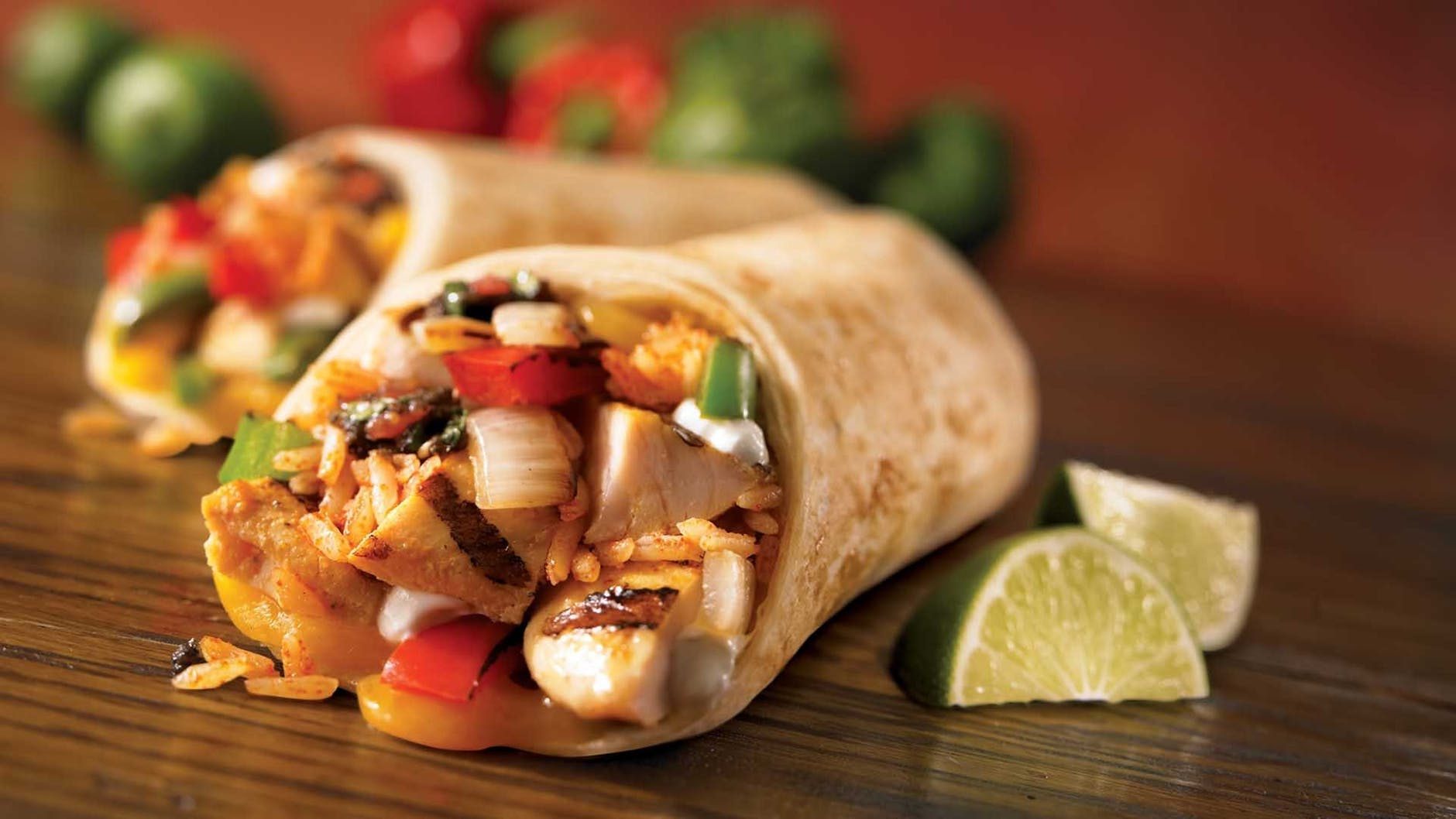
I first encountered the mission burrito when I visited Ho’Brah in Bay Ridge, Brooklyn for our first assignment. This meal was touched on a bit in this previous work, but I don’t feel like I elaborated on it very much, so it interested me as the topic of research for this. I’ve also written a concise blog post on it, but it also lacked the detailed insight I plan to provide in this piece.
I was initially under the impression that all burritos were just, well, burritos and that each taqueria simply etches their own version of the burrito when it comes to the ingredients and condiments. This ignorance, admittedly, was brought to light here. This king-sized burrito was quite literally an eye-opener for me.
:format(webp):no_upscale()/cdn.vox-cdn.com/uploads/chorus_asset/file/4320127/ElementsLaTaqueria_PChang-2231.0.jpg)
I had no idea what it was going to look like when I ordered this plate (it just sounded very good on the menu!). I even thought that the title ‘mission’ was just Ho’Brah’s personalized name for the dish considering the theme and origins of the restaurant. According to their message, they got some of their recipes from San Diego, where the Mission Bay is located.
These mission burritos are also sometimes regarded as ‘San Francisco burritos’ because their rise in popularity stems from that California city. They gained traction during the 1960s and can be identified mainly be their largeness in size. This is no myth either; I was in awe at the sheer size of this colossus when it got to the table. As an additional characteristic of recognition, it may also include extra rice than your average burrito.

A common cooking method for the mission burrito is to steam the flour tortilla to improve its workability, so to speak. This makes it easier to apply the other ingredients, in general, but it’s also not out of the ordinary to grill them. They are quite frequently wrapped strategically inside aluminum foil as an effort to uphold the burrito’s integrity. Due to its immense proportion, there is great potential that the burrito falls apart at the weight of all the meat and rice amongst other condiments.

Otherwise, if it becomes dismantled, you’ll find yourself eating this concoction merely with a fork, and where’s the fun in that? Part of the mission burrito experience is the challenge of navigating a way to eat it! Jokes aside, I certainly do believe the uniqueness of the mission burrito experience becomes undermined if you allow it to become disassembled. Its largeness is what makes it special in comparison to other burritos and picking at it deconstructed with utensils subverts the entire ordeal.
The ingredients of this burrito are usually left up to the customer’s preference, as Courtney Holcomb of Culture Trip writes an article discussing the history and aspects of the dish. It composes of their ‘choice of rices, beans, salsas and meats’ (Holcomb). She even brings up a ‘super’ mission burrito as a potential option. This variation consists of ‘cheese, sour cream, avocado or guacamole, and sometimes shredded lettuce’ (Holcomb). This seems to be more of a California thing because this alternative wasn’t offered at Ho’Brah.

As mentioned earlier on, we understand that the mission burrito started to gain popularity during the 1960s, but how it has evolved over time is difficult to trace. John Birdsall writes in an article for the magazine, Bon Appétit, that this dish is ‘so fused to California’s relationship with Mexico that its evolution is nearly impossible to chart’ (Birdsall). I have a hard time interpreting this, but the following point makes it a little easier to comprehend.
There’s a creation dispute between two of the alleged birthplaces of the mission burrito. San Francisco’s Taqueria La Cumbre claims to have invented it on September 29, 1969, but El Faro says they created it on September 26, 1961. If we don’t know who really was the first to make the mission burrito, it becomes far-fetched to detect its true origins and lineage.
:format(webp):no_upscale()/cdn.vox-cdn.com/uploads/chorus_asset/file/4320057/ElementsLaTaqueria_PChang-2072.0.jpg)
Birdsall gives us the rundown for the mission burrito production at El Farolito in San Francisco in this piece as well. He calls the carnitas ‘savage and salty’, stating they ‘dominate’ the tastes you experience from this super burrito. This immense amount of pork diminishes the flavor of the Mexican rice that’s included, he suggests. There are also avocado slices oozing about, which Birdsall deems ‘necessary’ as a crema for a cooling element. Birdsall concludes that this burrito both serves as ‘one of the defining ones in the Mission style’ and ‘one of the great burritos of San Francisco’.
Birdsall also speaks on a Mission street taqueria called El Castillito and he believes ‘this is the kind of place where the Mission burrito was nurtured’ (Birdsall). To my pleasant surprise, Gustavo Arellano is mentioned here at the end of the article, and apparently he ‘loves these burritos’ at El Castillito.
The place is not particularly well-known and a bit unsung when it comes to food review outlets. Birdsall gave Arellano a call to ask for his take as to why a restaurant that has such delicious burritos doesn’t receive a lot of exposure or advanced reputation. Places like the aforementioned La Cumbre and El Faro are considered ‘historical’ landmarks, for instance.
Arellano thinks El Castillito is able to lay low ‘because it stayed resolutely working class’. Furthermore, he even points out ‘there’s ones that become Instagram and Yelp sensations, and then ones that are better’. In other words, they seem to have stayed away from becoming commercialized and the taqueria sticks to its roots as our proverbial ‘mom and pop shop’. Arellano suggests the ‘Instagram and Yelp sensations’ may not quite hold a candle to the lesser-known joints.
We understand that sometimes these more famed and renowned ‘sensations’ can be focused on being profit-oriented, altering the ingredients of their dishes to appease a perhaps different culture group. The objective of El Castillito, however, is to solely provide the most authentic Mexican experience.
I’ve spent a good portion of this piece discussing the content of Birdsall’s work because it gave me a great deal of insight on the various mission burrito experiences in San Francisco. I’m giving it extra attention due to this, as he provided a whole lot of valuable information to unpack. Finally, as we reach the end, he describes the confines of the mission burrito at El Castillito.
He regards the pastor pork to have ‘crisp around its dark edges, chewy, and animated by a charge of vinegar and heat that bucks like a gun in recoil’ (Birdsall). That’s one way to express those spicy sensations! He says the rice has ‘tooth’ and the beans have a ‘fine grain’. I’ve never seen the word, tooth, used in this fashion, so I’m not sure what he means by this. Maybe the rice has a roughness to it (beats me)?
The flour tortilla features a ‘satisfying tightness’ and it ‘feels good in his hand’, he claims. We can all relate to this; no one wants a flimsy burrito! He finishes up by wondering if ‘this could be the best Mission burrito in the world’ (Birdsall). Strong words for a place that is widely unknown! El Castillito’s authenticity has lasted with a barrier to ‘obscure it from the tourists, the techies, and the condo buyers’ (Birdsall). It’s only a matter of time before this barricade is penetrated; a place this good can only remain hidden for so long.
An article from Eater by Hillary Dixler Canavan chronicles the five major elements of a mission burrito at the San Francisco Mexican restaurant, La Taqueria, which opened back in 1973. They use corn tortillas for their tacos, but flour tortillas for their burritos. The owner, Miguel Jara, purchases them from the supplier, La Colonia in San Jose, who are well-established tortilla makers.
Jara initially wanted his tortillas to be homemade when the place opened its doors, but they simply were unable to afford to have enough ingredients. They even actually custom-make 13-inch tortillas for him because 12-inch ones are too small, and 14-inchers are too big.
:format(webp):no_upscale()/cdn.vox-cdn.com/uploads/chorus_asset/file/4319663/la_taqueria_burrito_numbers_elements.0.jpg)
Next, they use fresh pinto beans that aren’t refried like for many other burritos. Canavan writes, ‘Jara cleans and then boils the beans for three hours, then fries them for an hour, leaving them whole’ (Canavan). They use two different types of meats for their mission burritos: beef, or carne asada, and carnitas. The cooking process for carnitas is a bit more delicate and complicated than that of the carne asada procedure.
Jara explains that if the carnitas get ‘too much fire, they get hard’, but if you ‘lower the flame and they go soft’. While the carnitas are seasoned with garlic, orange and salt, Jara says their beef is not marinated. They only brush the beef with their own special ‘sabor’.
:format(webp):no_upscale()/cdn.vox-cdn.com/uploads/chorus_asset/file/4319993/ElementsLaTaqueria_PChang-1986.0.jpg)
:format(webp):no_upscale()/cdn.vox-cdn.com/uploads/chorus_asset/file/4319673/ElementsLaTaqueria_PChang-1921.0.jpg)
:format(webp):no_upscale()/cdn.vox-cdn.com/uploads/chorus_asset/file/4320007/ElementsLaTaqueria_PChang-2144.0.jpg)
As for the toppings, La Taqueria uses their personal hot sauce recipe which consists of serrano peppers, tomatillos, salt, onion, and garlic. On top of that, they apply a salsa recipe of onion, tomato, and cilantro. Finally, Jara uses a guacamole that is merely made of avocadoes with no tomato, cilantro, or even salt.
:format(webp):no_upscale()/cdn.vox-cdn.com/uploads/chorus_asset/file/4320021/ElementsLaTaqueria_PChang-2010.0.jpg)
To think all this research was conducted on the heels of me getting a burrito for lunch one day is a wild proposition for me. I didn’t even realize its identity when I was eating it, let alone its story. The mission burrito has been around for around five or six decades, so it doesn’t go as far back as other Mexican dishes.
It’s interesting to see how all these taquerias put their unique spin on it while still upholding its authenticity. Even a place like Ho’Brah in New York tries to remain consistent and honor the California mission burrito tradition with their ingredients.
Works Cited
Birdsall, John, and Alex Lau. “The Story of the Mission Burrito, Piled High and Rolled Tight.” Bon Appetit, 11 Oct. 2016, www.bonappetit.com/restaurants-travel/article/burrito-october-feature.
Canavan, Hillary Dixler. “The Story of La Taqueria’s Remastered Mission-Style Burrito.” Eater, Eater, 4 Dec. 2015, http://www.eater.com/2015/12/4/9835360/la-taqueria-mission-style-burrito-san-francisco.
Holcomb, Courtney. “A Brief History Of The Mission Burrito.” Culture Trip, The Culture Trip, 30 Nov. 2016, theculturetrip.com/north-america/usa/california/articles/a-brief-history-of-the-mission-burrito/.
“Mission Burrito.” Wikipedia, Wikimedia Foundation, 4 Mar. 2020, en.wikipedia.org/wiki/Mission_burrito.
 Taco Literacy