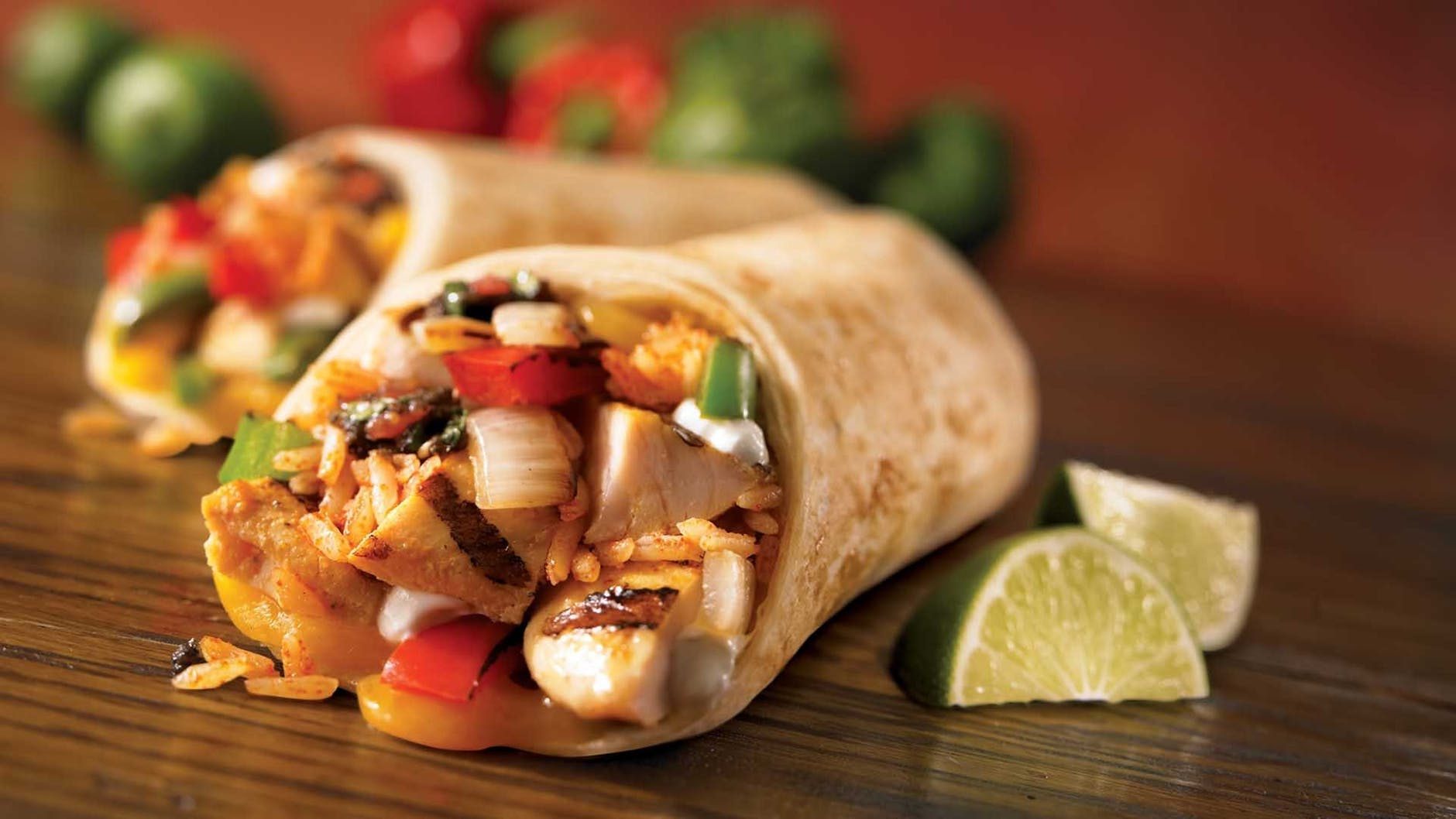
The term ‘foodways’ is something I’ve become much more cognizant of from taking this course. Our class mainly pertained to the foodways of Mexican culture, but it also looked at the relationship between Mexican food and its varying adaptations around the globe.
Now I wonder about the foodways of my Italian culture. How has food with Italian origins been used here in New York? What group of people was the food originally intended to serve? Does it hold up with peoples’ standards today versus over the course of history? I have a story that demonstrates how pizza, an Italian dish, was carried over from an Italian immigrant to New York and indirectly created an iconic pizza joint and culture within Brooklyn.
I was originally going to talk about my mother for this assignment, but I feel like the story of my late father’s side of the family is one that I have to share. No disrespect to mom whatsoever, but I would be doing my father’s family lineage and legacy a great disservice if I didn’t cover it here. I wish I could’ve spoken to him for this assignment as his family’s story dates back over a century ago now. His name was Louis Barbati, but most called him Louie, or Lou Lou.
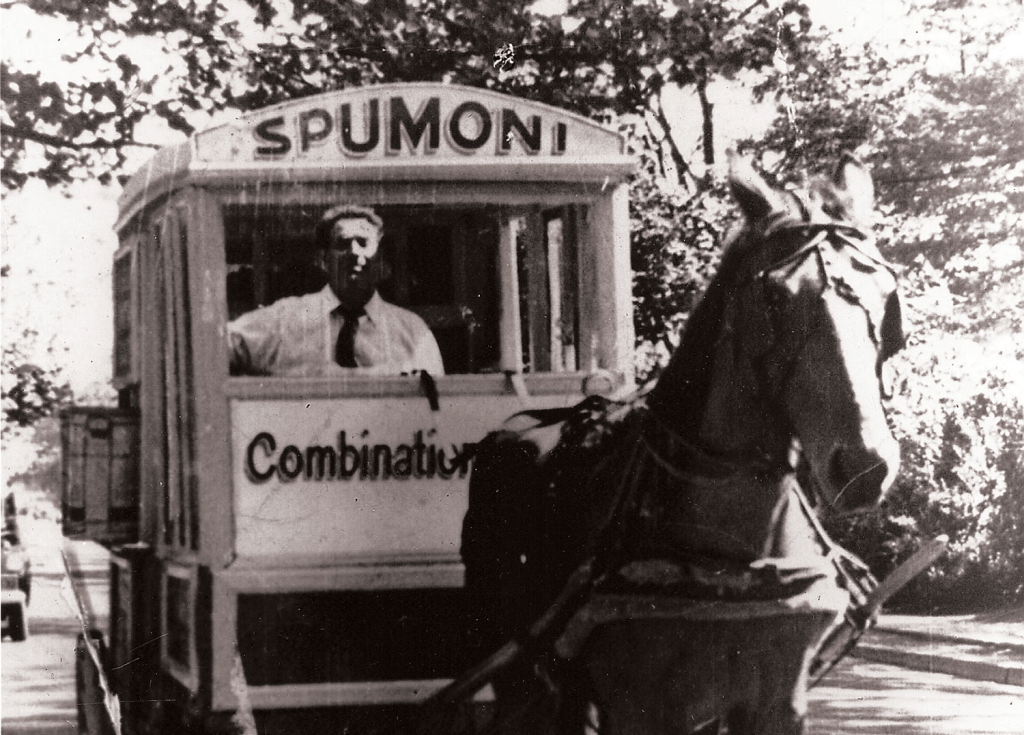
His grandfather and my great grandfather, Ludovico Barbati, came to New York from Italy in 1917. He started an Italian restaurant in Bensonhurst, Brooklyn called L&B Spumoni Gardens. Early on, however, he sold his ices, specifically spumoni, by traveling around the Bensonhurst and Gravesend neighborhoods with a horse and wagon in 1918.
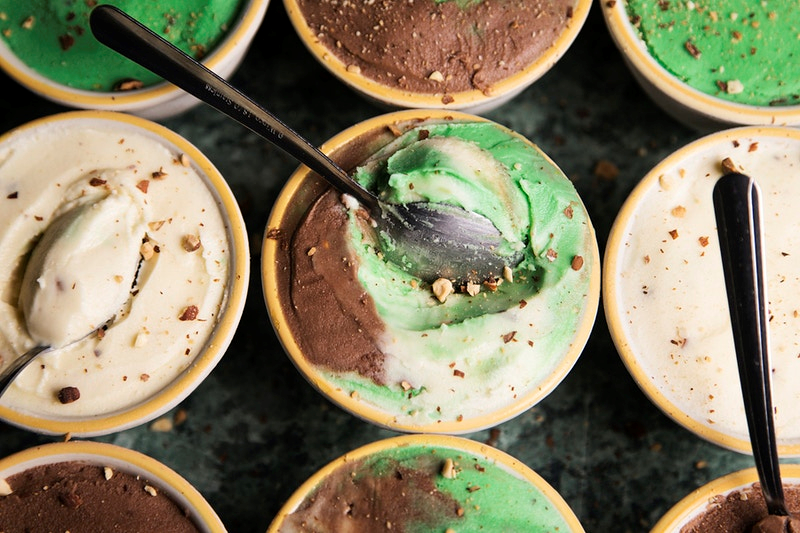
My aunt, Camille, who is my father’s sister, discussed the early days of the business in an interview with NBC New York. She talked about how my great grandfather started by off by making the spumoni in the basement of his house. L&B’s spumoni is a mixture of chocolate, pistachio, and ‘cremolata’ (cream-flavored ice cream) gelato with chopped roasted almonds. “He had his horse and he would go up and down the blocks and sell his spumoni for 2 or 3 cents a cup”, she explained.
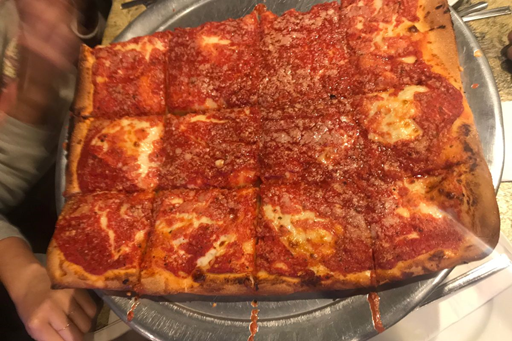
The restaurant first began only as a place that sold spumoni and ices back in 1938. In 1939, Ludovico had a pizzeria built where the present-day eatery is located. It specialized in serving Sicilian-style pizza. While they also sold round pies, they became well-known for their thick, square pizza that unconventionally put the tomato sauce over the cheese and dough. Some may call it an upside-down pizza.
In an article on Eater, Robert Sietsema describes the purpose of this method. “Putting the cheese underneath the tomato sauce, sometimes called the upside-down Sicilian style, is intended to keep the crust from getting soggy”. This style demands the pizza get under-cooked a bit, so it doesn’t burn. It makes a for a very doughy piece of pizza. Kara Zuaro explains in an article for Brooklyn Based that the pizza is “thicker, doughier and chewier than a round pie, with the perfect amount of crunchy char on the bottom and around the outside”.
When talking about what has made L&B such a popular New York eatery, my aunt said that “we became a franchise of our own selves”. Spumoni Gardens did not intend to become a phenomenon in New York. It wasn’t even necessarily designed to cater to a specific set of customers, such as Italian people. Part of this culture for the restaurant is to hold food as an element of unity. It seeks to bring all New Yorkers together as well as attract others from all walks of life.
Lore Croghan writes in an article for the Brooklyn Daily Eagle, “as far as I’m concerned, pizza isn’t like political parties”. Some people prefer thin-crust while others like thick-crust. It’s not necessary to pledge allegiance to a certain side.
My aunt explained how L&B “is a place to come to get away from the world, to go back in time to a good time, no matter what time it is, and this world is it”. This embodies the culture of Spumoni Gardens as a place that unifies the people with the food and the historical context of the business.
While it’s a restaurant that serves Italian food, L&B has established its very own culture as a family business. It’s not a chain like McDonald’s, as my aunt pointed out. I am reminded that while the mission burrito is a Mexican dish, it has its own culture amongst people of other places than Mexico. It’s an extremely meaningful symbol for the folks of San Diego and San Francisco through local mom and pop shops.
That’s what L&B started as. The Italian food instituted its own culture in Brooklyn. L&B’s pizza and spumoni has become a symbol of Brooklyn culture, like the mission burrito is a symbol of California culture.
Speaking further on the relationship between L&B and its Brooklyn roots, my aunt spoke in another interview this time with the Food Network. She stressed how “when you come to this place, all you have is happy times. Food makes you happy. Family and friends make you happy.” It’s not an exclusive culture. It’s a place for anyone to enjoy the experience of being a part of one of New York’s food landmarks.
In an episode of Man v. Food with Adam Richman from 2011, my dad, Louis Barbati, was interviewed and gave a brief walkthrough on how the pizza is made. In the YouTube video above, the whole segment of the episode occurs between 5:36 and 10:04. “We make five pounds of dough for each square”, he explained. The sauce has “salt, pepper, oregano, and San Marzano tomatoes”.
What makes the pizza stand out, though, is the method of which the ingredients are compiled. It’s not just about these ingredients or a ‘secret recipe’ that has made it popular, but about the construction that marks it with its distinctiveness. People in elementary and high school would always ask me what this ‘secret recipe’ for the pizza is. All I could say the trick was that the sauce was poured over the cheese instead of vice versa.
“We do it differently here”, my dad said to Adam. That’s essentially been the calling card of the pizza since its conception. The uniqueness of putting the sauce over the cheese has become an intriguing technique that is partly responsible for making it outstanding over the years.
My father’s restaurant is a little more old-fashioned, I’d say. Besides your traditional round pizza and the square, Sicilian-style, the L&B pizzeria doesn’t serve any other type of pizza if you don’t include having different toppings such as pepperoni. It may not be as modern as other Italian restaurants, but its stance on upholding its tradition has helped keep its identity and authenticity as a classical Italian eatery in New York.

L&B is a landmark restaurant in New York and especially in Brooklyn that’s been around for over 80 years. In that time, the pizza has never been changed in a way that would remove its authenticity as New York pizza. The spumoni has similarly not been altered as well.
Something my dad used to say to show his passion for the business was that spumoni was in his blood and his green veins had pistachio flowing through them. I actually found a video on YouTube of him saying it during a segment from when NY1 once visited. The video has to be from the 1980s. At the 9:49 mark, he said, “it’s in my blood. See the green veins, that’s pistachio!”
Works Cited
Croghan, Lore. “A Southern Brooklyn Stroll That Ends in L&B Square Slices.” Brooklyn Eagle, 23 Oct. 2019, brooklyneagle.com/articles/2019/10/16/a-southern-brooklyn-stroll-that-ends-in-pizza-squares/.
Sietsema, Robert. “80 Years Later, L&B Spumoni Gardens’s Food Is Just as Great as Ever.” Eater NY, Eater NY, 1 July 2019, ny.eater.com/2019/7/1/18713625/l-b-spumoni-gardens-brooklyn-gravesend-restaurant-review.
Zuaro, Kara, and Eleizer Perdomo. “Revisiting the Classics: L&B Spumoni Gardens.” Brooklyn Based, 1 Nov. 2019, brooklynbased.com/2019/04/17/revisiting-the-classics-lb-spumoni-gardens/.
 Taco Literacy